Why Fixing Paso Robles Roads Is More Complex—and Costly—Than It Looks
From pavement conditions to funding realities, maintaining 150 miles of city streets requires long-term investment, strategic planning, and careful prioritization.
Understanding Road Conditions and Costs
The City uses a Pavement Condition Index (PCI) to measure road quality on a scale of 0 to 100, with 100 representing a brand-new street. Paso Robles’ average PCI is 54, compared to a statewide average of about 67. Conditions vary across the city, with the east side averaging 61 and the west side 47.
Timing is critical. Streets with a PCI above 60 can often be maintained with lower-cost surface treatments. Once they fall below that threshold, deterioration accelerates and repairs become far more expensive, often requiring reconstruction of the underlying base.
The scale of need is significant:
Improving the average PCI from 54 to 59 would require about $12 million annually for 10 years
Reaching an average PCI of 80 would require roughly $25 million annually for 10 years
Current funding levels fall well short of these amounts, making prioritization essential and progress gradual.
Challenges for the City
Paso Robles faces several unique challenges:
Large local road miles relative to population, the City maintains more roadway per person than other cities
San Luis Obispo: 126.75 mi, 57 residents (1,000’s), 2.22 mi/1000 residents
Arroyo Grande–Grover Beach–Pismo Beach: 146.19 mi, 51 residents (1,000’s), 2.87 mi/1000 residents
El Paso de Robles–Atascadero: 301.03 mi , 60 residents (1,000’s), 4.43 mi/1000 residents
City of Paso Robles: 150 mi, 32 residents (1,000’s), 4.69 mi/1000 residents
Older streets often require more intensive improvements, including ADA-compliant curb ramps and sidewalks. Treatments like grind and overlay can trigger federal ADA requirements, significantly increasing project scope and cost—especially on many west side streets
Many older roads also require underground utility upgrades. While this will increase initial project costs—sometimes by up to 40%—completing utility work concurrently with road repair avoid tearing up newly improved streets later, protecting long-term investments and reducing future disruption
What the City Is Doing
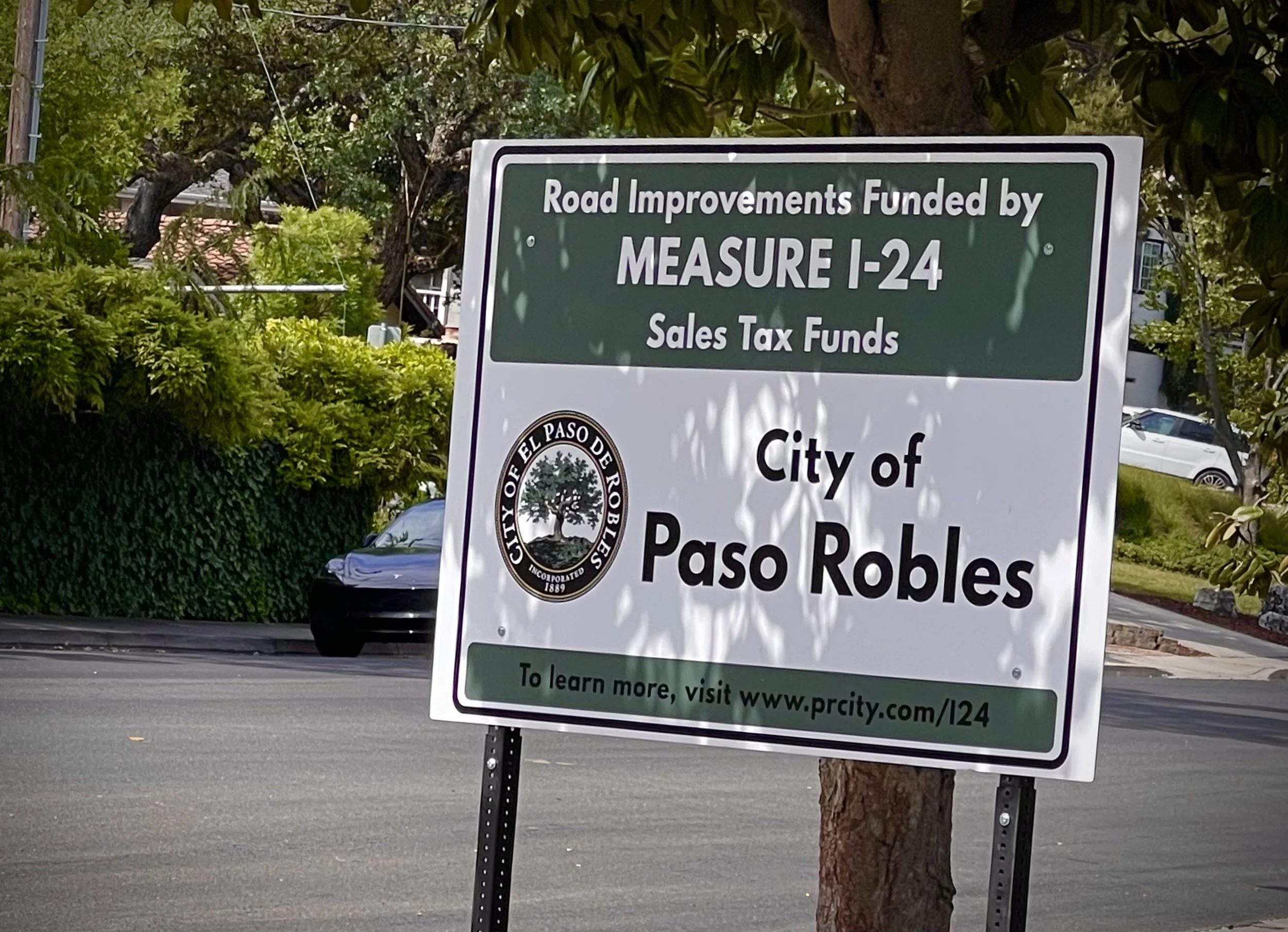
Paso Robles’ supplemental sales tax—Measure E-12 (2012–2024) and Measure I-24 (current)—funds street repairs across roughly 150 lane miles of roadway. These local funds are combined with Measure J-20, state gas tax revenue, grants, and other sources.
The supplemental road tax generates about $5.5 million annually, serving as a foundation to secure additional funding. Local dollars are leveraged to bring in outside resources, allowing total investment to exceed local tax revenue. Actual annual expenditures will vary year to year based on timing, duration of the project, scale of project(s), and amount of outside funding.
Since 2013, the City has completed 36 projects totaling about $49 million, averaging roughly $3.7 million annually. Examples of completed projects include:
Dry Creek Road — $4.5 million
Spring Street (1st–15th) — $4.1 million
12th Street (Spring to Fresno) — $2.8 million
Golden Hill Road — $2.6 million
Rambouillet / Nicklaus area — $2.6 million
Sherwood / Creston / Linne — $2.4 million
There are currently 17 active projects totaling about $60 million, including:
Creston Road Phase 1 - $12.1 million (note: this is nearly complete)
Creston Road Phase 2 — $10.9 million
Sherwood / Sierra Bonita — $7.7 million
24th Street Bridge — $4.1 million
13th Street / Niblick Bridge — $3.3 million
Sunset / Panorama — $2.6 million
Melody Drive — $3.1 million
These figures of completed and active projects are always changing due to the dynamic nature of road projects.
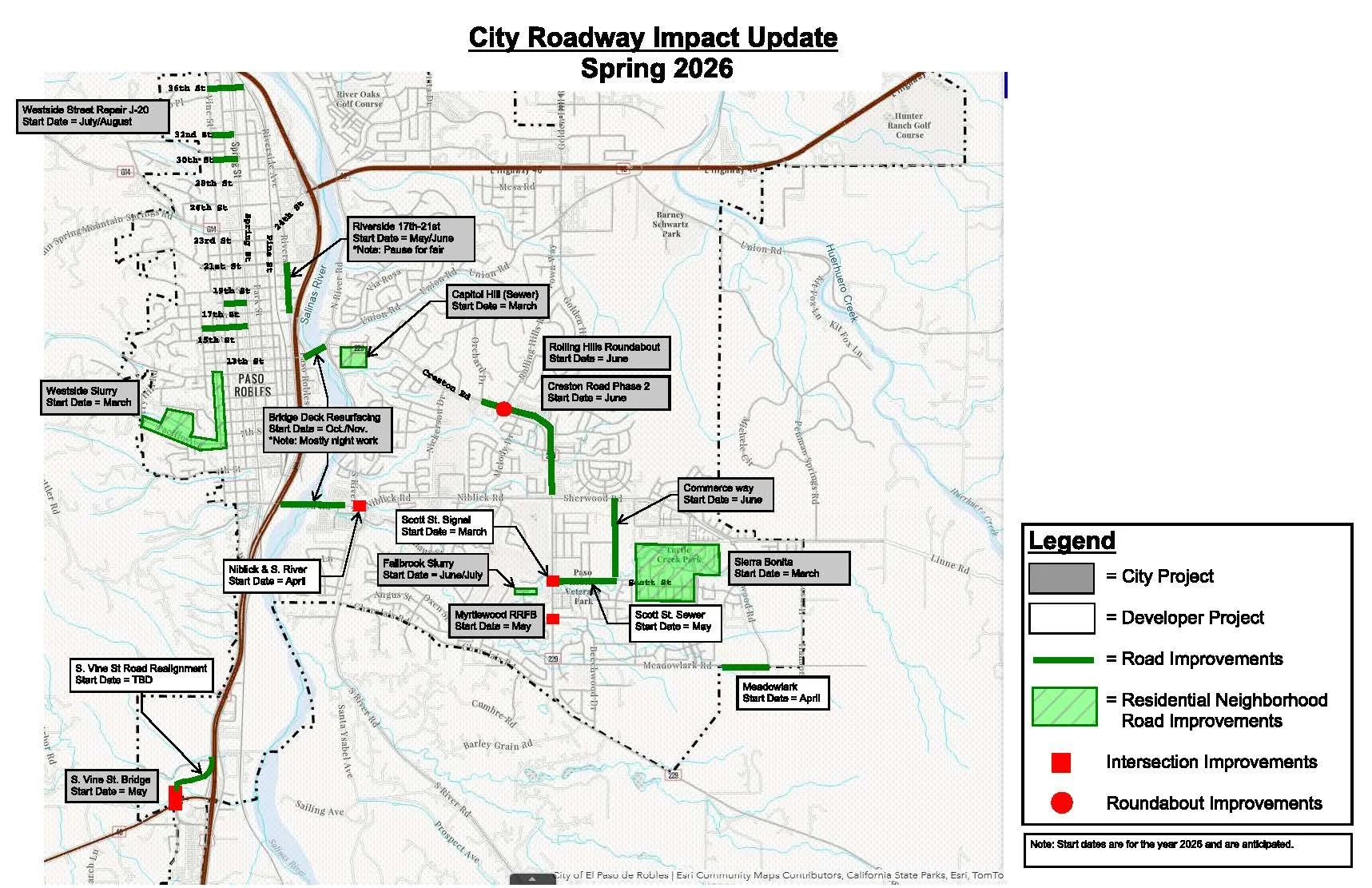
Overview of City of Paso Robles roads projects in some phase construction (Spring 2026).
A New Approach to Sequencing Road Repair
The City’s new rolling Five-Year Capital Improvement Program (CIP) replaces the previous fixed six-year model, allowing priorities to be updated with each two-year budget cycle, projects to be accelerated as funding becomes available, and emerging needs to be addressed more quickly. By advancing projects concurrently across design, engineering, and construction, the City can reduce downtime and maintain a more consistent, sustained pace of investment in street repairs.
In addition, the City has allocated $500K for minor projects (less than $75K) to be completed in house. This will facilitate completing special projects (that are more involved than filling potholes) on an ongoing basis.
Final Thoughts
Maintaining and improving Paso Robles’ roadway system is a long-term effort that requires steady investment, careful planning, and disciplined prioritization. With limited resources and significant need, the City must continually weigh costs and benefits—leveraging local funding with outside resources to deliver the greatest possible impact each year.
For those that are interested in roads, Public Works makes a monthly council presentation on projects on the first Tuesday of the month (old presentations can be viewed on YouTube and powerpoints are also available). In addition, the Supplemental Tax and Oversight Committee reviews plans, progress and budgets of the city’s supplemental taxes — they meet quarterly and are open to the public.
References and Resources
Supplemental Tax Oversight Committee (February 18, 2026) Includes information on projects completed and in progress
Road Repair Plan (September 16, 2025 Presentation to Council) Includes details on new major projects and 5 year capital improvement program, overview of dollars vs time of road repair, and more